
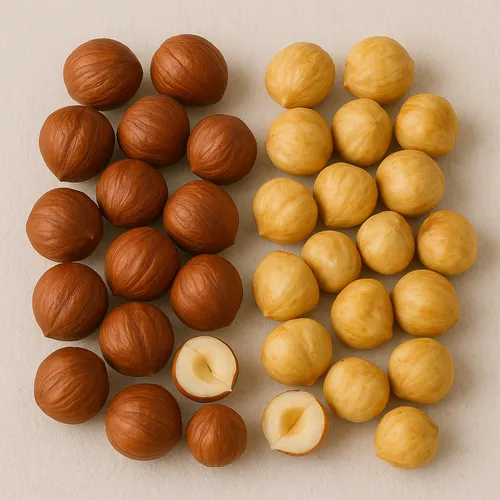
How roasting changes flavor, texture and industrial performance
Roasting transforms hazelnuts by reducing moisture, intensifying aroma, improving crunch and enhancing color. For manufacturers, the choice between raw and roasted depends on how the nut will be processed afterward and what sensory profile the final product requires.
- Raw hazelnuts deliver a mild flavor and softer texture, ideal for further roasting inside doughs or with chocolate.
- Roasted hazelnuts offer a stronger aroma, firmer crunch and darker color, suited for final applications that do not undergo additional heat.
Typical applications for raw hazelnuts
Raw hazelnuts are most often used in formulations that include internal roasting or heat processing. This allows the aroma to develop naturally during production while preserving flexibility in roast intensity.
1. Chocolate and praline manufacturers
Many chocolate factories prefer raw hazelnuts because they roast them in-house to achieve their signature flavor. Tight control of roast level is critical for consistency, especially in gianduja and praline pastes.
2. Bakery items baked at high temperatures
Products like breads, cookies and pastries naturally roast the hazelnuts during baking. Using raw kernels prevents over-roasting or burning, which could cause bitterness.
3. Oil extraction and pastes
Raw hazelnuts are used for cold-pressed hazelnut oil and certain paste varieties where a lighter, cleaner flavor is desired.
Typical applications for roasted hazelnuts
Roasted hazelnuts are selected when the nut must deliver immediate aroma, strong flavor and a ready-to-use crunch without additional cooking.
1. Premium toppings
Ice cream, gelato, frozen yogurt and dessert cups rely heavily on roasted diced hazelnuts for their color, aroma and stability.
2. Snacks and confectionery coatings
Roasted hazelnuts pair exceptionally well with chocolate coatings, sugar glazing and caramel systems.
3. Ready-to-eat cereals and granola
High-temperature roasting gives hazelnuts a durable crunch that remains stable during storage and distribution.
Understanding roast levels: light, medium and dark
Turkish suppliers offer multiple roast levels depending on the intended use:
- Light roast — subtle flavor, suitable for white batters, cereal bars and bakery items.
- Medium roast — the most common industrial choice, balancing aroma and color.
- Dark roast — intense flavor for chocolate systems or premium toppings.
Buyers often match roast levels to regional consumer expectations: European markets often prefer medium-to-dark, while Asian markets may choose lighter profiles.
Performance differences in chocolate applications
Chocolate manufacturers pay close attention to roast level because it influences:
- Oil migration — roasted nuts release oils more readily, affecting texture and shelf life.
- Flavor integration — roasted nuts contribute more aroma with less required dosage.
- Crunch stability — darker roasts offer more crunch, but may soften faster in fillings.
Raw kernels coated in chocolate roast naturally during enrobing, creating a unique flavor profile.
How to choose between raw and roasted hazelnuts as a buyer
The simplest rule is: If your product applies heat, choose raw. If your product is ready-to-eat, choose roasted.
Additional considerations include:
- Desired flavor intensity
- Expected storage time
- Required crunch level
- Moisture migration concerns
- Finished product color expectations
Specifying roast level, cut size and packaging (vacuum or MAP) ensures consistent industrial results.
Summary
Raw and roasted hazelnuts each bring distinct advantages depending on the application. Raw kernels perform best in heat-processed products such as baked goods and chocolate manufacturing, while roasted hazelnuts dominate ready-to-eat toppings, snacks, cereals and confectionery.
Atlas offers all hazelnut formats — raw, roasted, diced, sliced, granulated and paste — allowing buyers to build complete assortments tailored to their production lines.